
Now, you know I love differentiation, profe. When it comes to supporting all of our students, I am 100% here for it. I know a lot of teachers say: “All teachers are special education teachers,” and it’s true.
That being said, supporting students with Individualized Education Programs (IEPs) is an essential part of creating an inclusive and successful learning environment. As educators, it’s important to go beyond meeting legal requirements and focus on fostering a classroom where all students thrive. In this post, I’ll share practical strategies to differentiate instruction, implement accommodations, and create meaningful connections with students with IEPs. I’m hoping these tips will empower you to confidently support your neurodivergent learners while balancing your workload and ensuring your classroom stays engaging for everyone.
TLDR: I’ve got a fantastic workshop, IEP Magic, which explores the ins and outs of IEPs with ease (and most importantly – how they relate to your class).

Understanding IEPs and Their Importance
As you may know, an IEP is an individualized education plan (or some variation of that text, depending on where you are). I don’t mean to overwhelm you, but it is a legal document. The IEP is created by a supportive team made up of the students’ teachers, family or guardians, and special education experts who know how to support this student based on their needs. The goal is to support a student who has a learning disability. Creating a full IEP takes time as it involves a lot of paperwork and assessment to verify where the student needs the most support.
From time to time, you might be asked to sit in on an IEP meeting and share information about a student. This meeting will help the team decide whether the IEP should stay in place, change at all, or disappear. In an IEP meeting, you should aim to share data and facts about a student rather than personal opinions, and – as a reminder – never ever translate for a family in an IEP meeting. As I mentioned, this is a legal agreement and there are trained professionals that your school can call to explain the ins and outs of IEPs in Spanish legalese.
All in all, the IEP is a collaborative document that supports a student with a learning disability. There’s also 504 plans, which are for medical concerns. A student with an IEP may have a 504 as well, but it’s not always the case.
How Does an IEP Impact Spanish Class?
Now that we’ve got the basics out of the way, let’s talk about your class. Remember, an IEP is a legal document, so you’ve got to follow it. Usually, the IEP will break down specific goals the student has for different content areas. I hate to break it to you, but World Language likely isn’t mentioned much in the IEP (sorry, profe). In this case, I look at the language arts or literacy goals the student has in place.
Differentiate: Scaffold for Students with IEPs
Like I said earlier, I am “your girl” for differentiation (I’ve even got a full post about it here). I’ve got a whole checklist of ways to accommodate students who need extra support, but my favorite way to support students who need it is scaffolding my materials.
Usually, I’ll backwards plan my lessons from the final activity to the very start of class, and scaffold the steps we’ll take to get there. This means I focus on the tasks and the content, and break them into bite-size chunks to teach and practice as we make our way through the lesson. I’ve also found that this is particularly helpful for middle schoolers who don’t have IEPs, just because their organization skills are still a work in progress.
Provide Choice
A huge way to provide differentiated support for your students is to provide choice, profe. I often encourage students to choose 5 from a set of 10 questions, to choose their projects from a choice board, to choose between option A and option B for review, etc. You get the idea.
I’ve got so many more ideas, but there are too many to list here. Grab my free differentiation checklist for all my differentiation strategies.

Use Accommodations and Modifications Effectively
I know what you’re thinking: Kathryn, aren’t accommodations and modifications the same thing? Nope.
Let’s Talk: Accommodations
Accommodations are adjustments made to enable a student to achieve in their own way. This means we adjust the way we get to the end goal, without changing the objective or expectations.
Some examples of accommodations are:
- how the information is presented (text, audio, lecture, etc.)
- the response (writing, speaking, drawing, etc.)
- setting (noise, lighting)
- timing and scheduling (time of day, extended time, length of assignment)
Some accommodations that you might implement in your Spanish class for students with IEPs are…
- Dictating instead of writing answers
- Reviewing directions
- Asking students to restate information
- Modeling concrete examples of what you expect students to accomplish
- Following a routine that supports student success
- Sharing your agenda on the board
- Provide choice in test format
- Pacing guides for projects
What About Modifications?
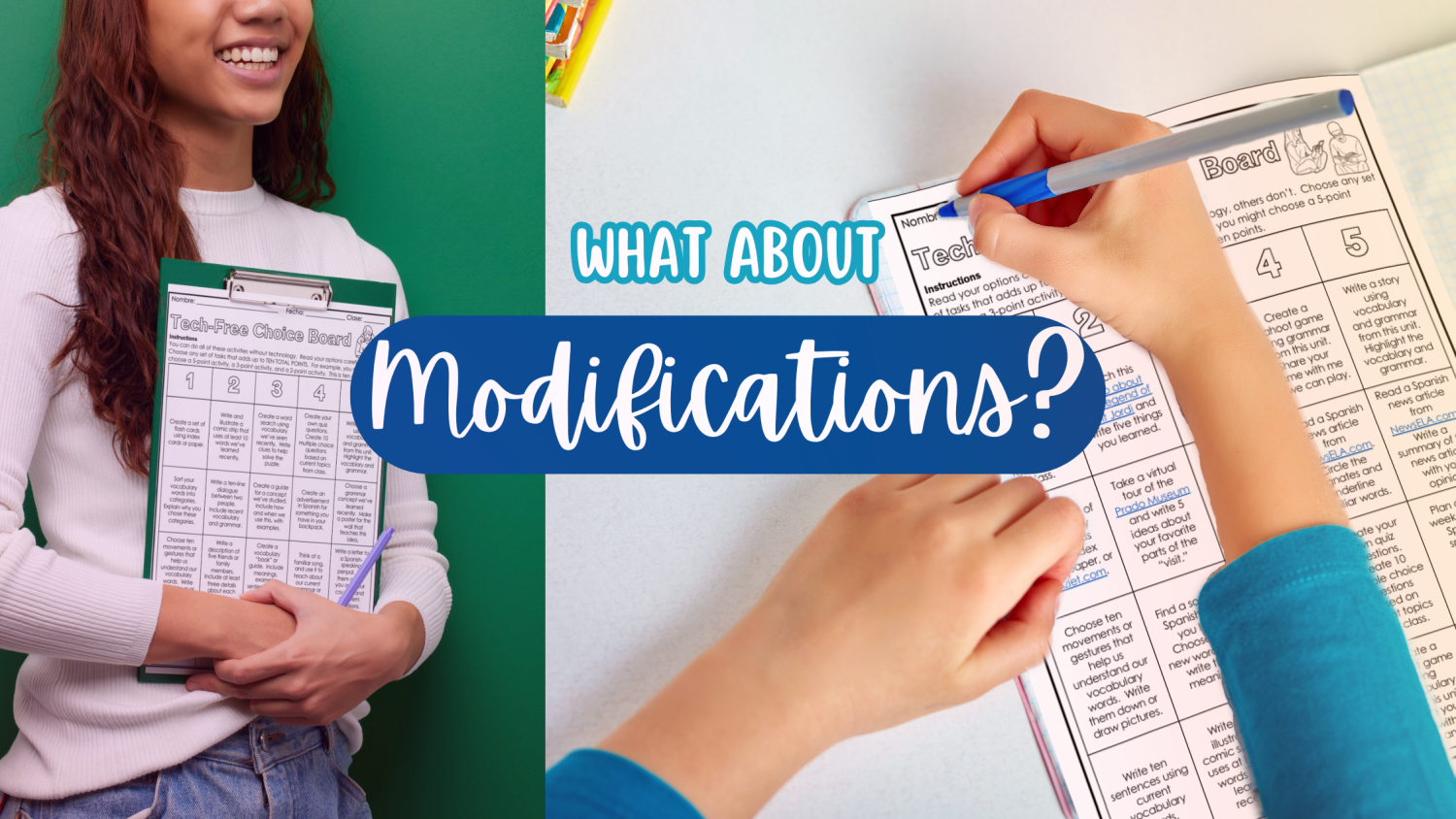
On the other hand, modifications are more about adjusting the process so students can succeed. This might mean modifying the workload, grading expectations, providing breaks, and adding adult intervention to support the student.
Some ways we modify work for students in Spanish class are…
- Reducing or adjusting the workload
- Offering projects instead of written reports
- Providing a word bank
- Modifying grades based on IEP
I learned more about accommodations and modifications from Let’s Go Learn. If you’re looking for more specific ways to differentiate support in your classroom, check out my free differentiation checklist.
Relationships are Key
I know, I know. You’re sick of hearing how important relationships are. But hear me out, profe. I’m going to tell you to build relationships with parents and other teachers. I know you’re already building connections with your students, and you already know how important that is.
So, let’s look at IEPs as an opportunity to connect with parents. Parents (usually) know their kids pretty well, and a kid with an IEP has a parent who advocated hard enough for that document to come into existence. It’s likely that the parent knows what can work for their child, and it’s definitely worth a phone call home to ask about what’s worked best for this student in the past.
This is also the perfect opportunity to connect with the special education teacher or case worker who manages this student’s IEP. This teacher likely knows the student pretty well, and they’ve seen how the student has struggled or succeeded in the past. Not only are we building relationships with families, but we’re collaborating with colleagues to determine how we can support the student. You might also pop in to visit their teacher from last year to hear what worked in their classroom.
Leverage New Tech Tools
Every time I ask for suggestions, my teacher friends have a ton of new online resources to share with me. When it comes to differentiation, my favorite tools are…
NewsELA
I’ve used this page since my ELA teacher days! NewsELA is a free news site for teachers and students that provides leveled texts in English and Spanish. I love that I can adjust the text level for my students to read at the level that’s best for them. The page even suggests vocabulary and pre-reading and post-reading activities, though I find the vocabulary in the quizzes to be a bit too advanced for my novice students.
Diffit
Diffit is an AI tool that you can use to adjust and create grade level content. They have a wealth of graphics organizers, which are helpful in supporting students in preparing their ideas. You can also use their tools to modify and adjust work.
Tools You Already Have
You might not realize, but there are loads of tools that you already have on hand too, profe. Your devices likely have a speech-to-text tool, and vice versa. This can be great for students who need audio support. Of course you can space out your worksheets too, even if you’re just cutting them up and taping them onto a new sheet of paper before making copies for those students who need extra processing space.
TL;DR
- IEPs are collaborative tools designed to support individualized learning needs.
- Differentiated instruction and accommodations help students thrive.
- Building strong relationships and leveraging students’ strengths is key.
- Collaboration with families and specialists ensures effective support.
- Technology and tools can enhance accessibility for neurodivergent learners.
Your Next Steps

Ready to feel confident in supporting your students with IEPs? Explore proven strategies and tools in my interactive workshop, IEP Magic, designed to help educators like you streamline planning, implement effective strategies, and reduce stress.
Or maybe you’re just looking for a checklist to help you differentiate en tu día a día. Check out my free differentiation checklist, right here. It’s perfect for popping on your clipboard and checking out as you lesson plan.
Supporting students with IEPs is a rewarding journey that requires intention, collaboration, and flexibility. By implementing thoughtful strategies, leveraging the right tools, and building strong relationships, you can create a classroom that embraces every learner’s potential. Start small, stay consistent, and watch as your inclusive practices make a profound impact on your students’ growth and confidence.


