
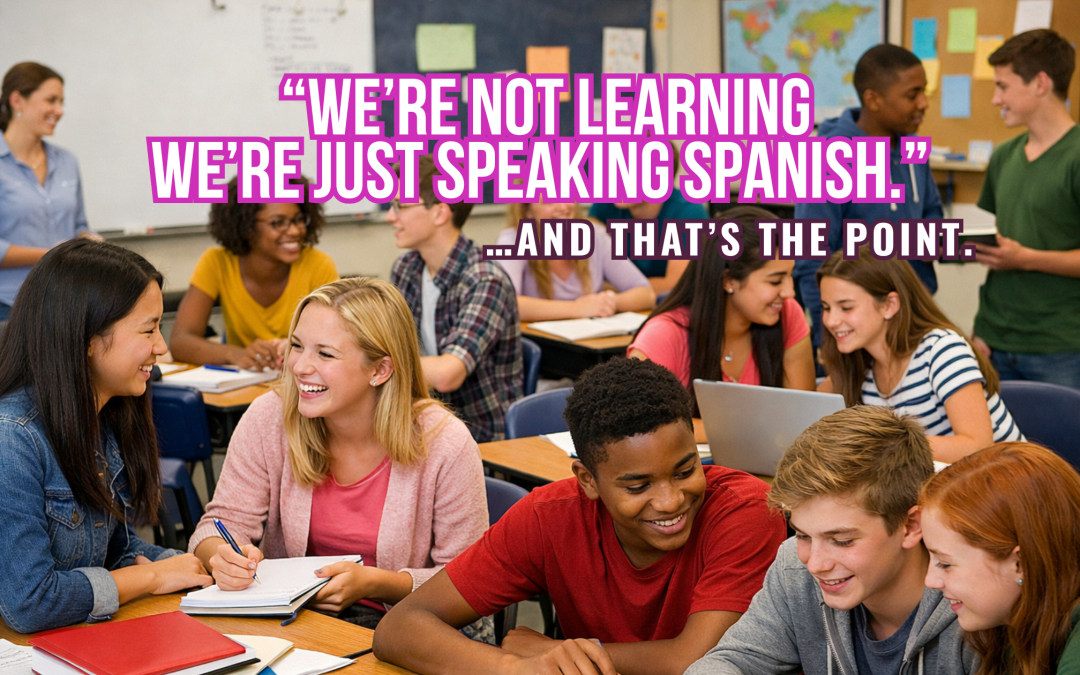
When I first started using more Spanish in my classroom, my students were not impressed.
“Hold up. Where’s the routine?” (more to come on this later, promise)
“Where are my notes?”
“How am I learning?”
One student actually said to me, “We’re not learning. We’re just speaking Spanish.”
And honestly? That was the goal.
But at the time, my students didn’t see it that way and I don’t blame them. They were used to structure, routines, note-taking, and a very specific idea of what “learning” looked like. When I introduced storytelling and started teaching more in Spanish, it felt really unstructured to them, especially at the high-speed college prep high school I was working in at the time.
So, let’s talk about what happened, what worked, and how you can start using more Spanish in your own classroom without losing your students (or your sanity).
What Does “Teaching in Spanish” Actually Mean?
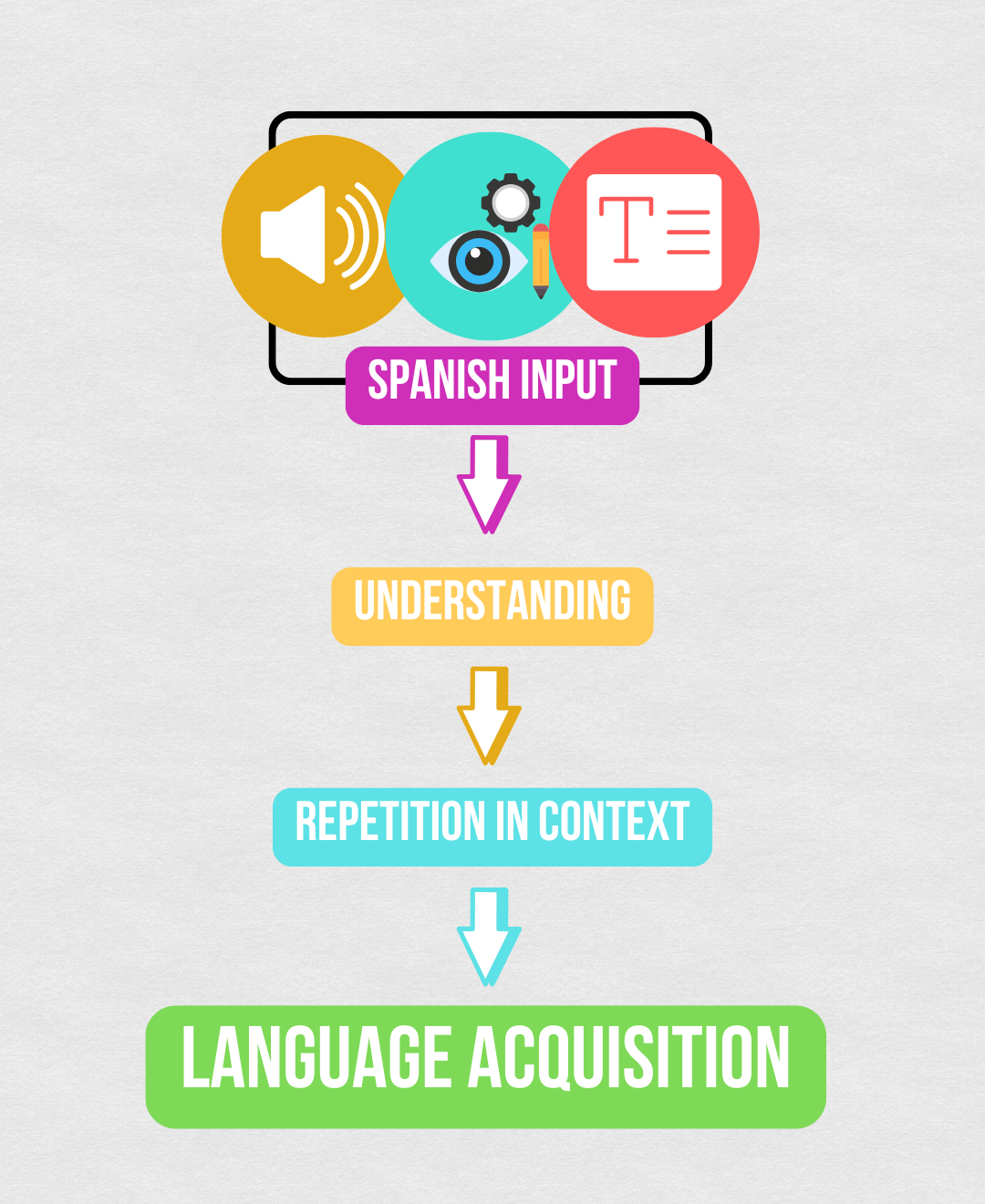
You’ll often hear terms like comprehensible input and acquisition-driven instruction used to describe teaching Spanish in Spanish.
- Comprehensible input means giving students Spanish they can actually understand through text, visuals, videos, music, gestures, and context.
- Acquisition-driven instruction focuses on helping students acquire language naturally by hearing it, using it, and interacting with it meaningfully.
Both approaches require using more Spanish in class, but with intention and support. This isn’t about throwing students into the deep end and hoping for the best.
(And if you’re thinking, “My Spanish isn’t good enough for that,” I’ve got another video that addresses that exact fear.)
The Pushback Was Real
At the time, I was teaching at a very rigid, no-nonsense charter school with strict procedures. My students were used to taking notes, memorizing information, and regurgitating it on quizzes. That works in some classes, but not in a language class if the goal is actual language use.
Students constantly asked:
- “What are we doing?”
- “We’re not learning.”
- “We were learning before.”
What I realized was this: they still needed structure; just not the same kind of structure they were used to.
So I adjusted.
How I Added Structure without Going Back to English-Heavy Teaching
This wasn’t an overnight transformation. Here’s what my early version of acquisition-driven teaching looked like:
- I previewed a small amount of vocabulary so students still had something concrete to hold onto.
- I taught through storytelling and comprehensible input, using visuals and repetition.
- After stories, students got written versions, comprehension questions, and more structured follow-up activities.
- We did retelling activities such as: summaries, drawings, writing, and eventually creating their own stories.
- My school required weekly quizzes, so I used story-based questions that reinforced language structures instead of isolated grammar rules.
This isn’t exactly how I teach now, but it was a crucial bridge for both me and my students.
The Results (a.k.a. the Part That Shocked Me)
Before this shift, I had taught Spanish 4. I once asked those students to write a story or essay; and they couldn’t. That was a wake-up call.
After switching to comprehensible input and acquisition-driven instruction?
My Spanish 1 students were outperforming that old Spanish 4 class.
Yes, it took time. That first year, all my classes essentially started at a Spanish 1 level. But as students moved into Spanish 2 and Spanish 3, they got stronger, not just better test-takers, but more confident language users.
I used a writing tracker (which you can get for free on my TPT), and by January of their first year, my Spanish 1 students were already writing 100 words. By the end of the year, they were asking for more pages so they could add details to their stories.
That’s when you know something is working.
So… Does Teaching in Spanish Work?
Yes. It works.
When students are given the right balance of:
- Meaningful Spanish Input
- Visual and Contextual Support
- Intentional Structure
…they acquire language more naturally and more effectively.
It’s not a free-for-all, but it’s also not a one-size-fits-all system.
Four Tips to Get Started Using More Spanish
If you’re ready to dip your toe in, here are four practical ways to start:
- Start small with circling questions
(Seriously – Google it. There’s tons of great info out there.) - Use visual input
Graphics, pictures, or ClipChat / MovieTalk help students connect meaning to language. - Always follow input with structure
Reading, writing, drawing, or short activities help students process what they just acquired. - Assess and check for understanding
Quizzes, activities, exit tickets; whatever works for you. “Check for understanding” may be a buzzword, but it matters.
Final Thought
Teaching in Spanish isn’t about abandoning structure, it’s about redefining it.
Find what works for you and your students, start small, and give yourself permission to grow into it.
If you have questions, drop them in the comments. I’m happy to follow up.
Ciao, profe.


